


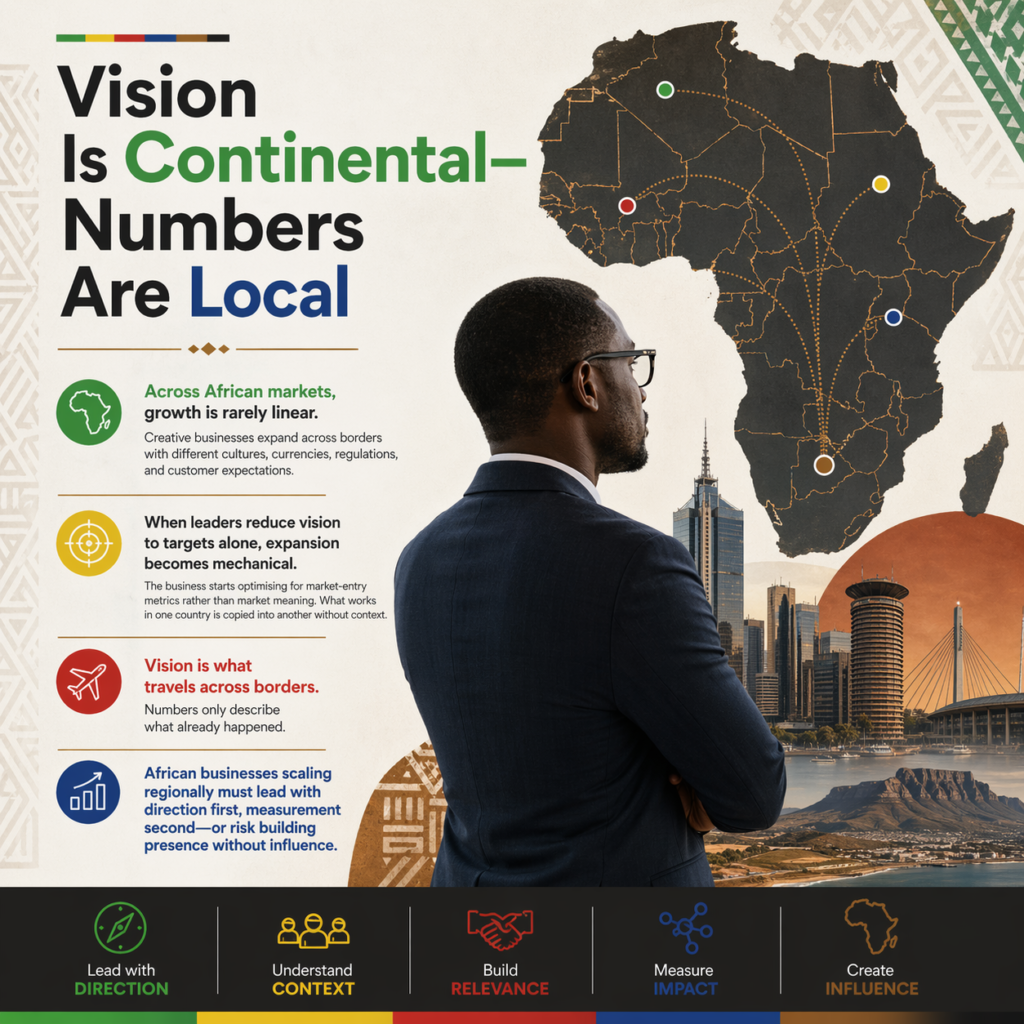
Turning a vision into metrics is a big practice in business that has been around for centuries. A business vision is not a scorecard. It is a direction of travel.
Yet businesses across Africa make a critical leadership mistake: they translate vision too quickly into numbers and then treat those numbers as the vision itself. Revenue targets, growth percentages, utilisation rates, and dashboards become the centre of gravity. Over time, leaders stop leading with judgment and start managing outcomes.
This is where vision quietly collapses.
Numbers describe what has already happened. Vision exists to guide what should happen next. When leaders confuse these roles, the business begins to drift—even if performance appears strong.
Vision is supposed to hold the organisation steady when conditions change. Numbers fluctuate. Markets shift. Platforms rise and fall. Culture evolves. A business that relies on numbers alone has no anchor when certainty disappears. The most dangerous moment is when leadership believes the numbers are the strategy.
Numbers Travel Poorly Across African Markets
African markets are complex by nature. Different currencies, languages, cultural norms, regulations, and buying behaviours coexist. Vision provides continuity amid this complexity, and numbers do not.
When creative businesses expand regionally using performance metrics as their primary guide, they often replicate models without adapting meaning. What worked in one market is rolled out mechanically into another. The business grows wider but not deeper. This produces a surface-level scale.
Clients may buy, but they do not bond. Teams execute, but they do not believe. Brands show up, but they do not belong. Over time, resistance grows—not because the offering is weak, but because the vision was never translated into local relevance.
Vision travels through context. Numbers do not.
Turning Vision Into Metrics Weakens Strategic Memory
When numbers dominate leadership conversations, time horizons shrink.
Creative businesses begin optimising for this quarter, this campaign, this pitch, this report. Long-term thinking becomes risky because it delays visible returns. Investment in research, talent development, and brand depth is postponed in favour of immediate performance. This creates a dangerous illusion: growth without preparedness.
The organisation forgets why certain choices were made. Strategy becomes reactive. Decisions are justified by performance rather than principle. When conditions change—as they always do—the business struggles to respond because it has lost strategic memory.
Vision exists to protect long-term intent from short-term pressure. When leaders surrender vision to numbers, the future is compromised.
What You Can’t Measure Still Runs the Business
Some of the most powerful drivers of business performance cannot be counted.
Trust.
Reputation.
Creative confidence.
Client belief.
These elements determine whether people stay, recommend, collaborate, and commit. Yet when leadership focuses only on metrics, these signals are ignored because they do not fit neatly into dashboards.
The damage is delayed but severe.
Customers disengage emotionally before they leave financially. Employees withdraw psychologically before they resign physically. Brands lose meaning before they lose visibility. By the time the numbers reveal the problem, it is already mature.
Strong leaders learn to listen beyond metrics. They read patterns, not just reports. They understand that numbers confirm reality—they do not create it.
Metrics Change Behaviour Before They Improve Performance
When people are judged primarily by numbers, behaviour adapts to survive measurement. Targets become defensive. Context is removed. Stories are shaped to protect performance. This is not always unethical—but it is always corrosive.
In creative businesses, this pressure suppresses experimentation. Teams stop taking risks. Collaboration weakens. People protect their outputs instead of the organisation’s future.
Performance may rise briefly—but innovation declines quietly. Once creativity contracts, relevance follows. And when relevance disappears, no amount of optimisation can save the business.
Vision Must Lead, Numbers Must Serve
This is not an argument against measurement. It is an argument for leadership maturity.
Vision should remain human, directional, and values-led. Numbers should support judgment, not replace it. Leaders must know when to listen to data—and when to listen to people, culture, and context.
The strongest creative businesses across Africa do not chase numbers blindly. They use metrics as signals, not commands. They grow slower—but stronger. They scale with meaning, not just reach. That is how vision stays alive.

Leave a Reply